For patients with complex care needs, AI is helpful—but the human touch is irreplaceable
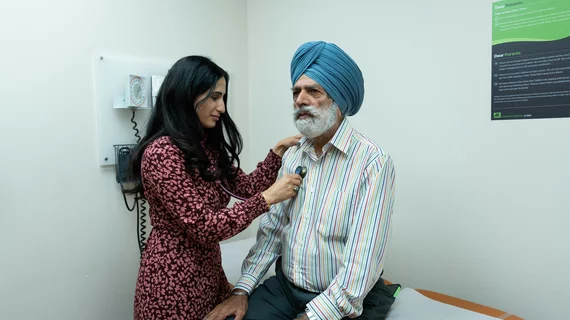
Primary care providers are excited about the promise AI holds to help them help patients living with multiple chronic conditions. However, they believe these patients will continue to need the human connection they get from their PCPs.
That’s according to an interview-based study conducted at the University of Birmingham in the United Kingdom. Dr. Jennifer Cooper and colleagues spoke with not only general practitioners but also geriatricians, nurses and pharmacists. Their study report went up July 4 in the Journal of Medical Internet Research.
“Our findings are important to software developers, healthcare providers and policy makers in navigating the development and regulation of AI tools for managing multiple long-term conditions,” the authors write. “There is currently limited guidance on how AI tools should be safely integrated into clinical practice, and clarity on the medicolegal implications for clinicians of using these tools is urgently needed.”
Here’s more from the paper.
1. Patients with multiple long-term conditions present complex care needs.
These include difficulties prioritizing multiple conflicting needs, managing multiple medications and navigating care outside single-condition guidelines. More:
These challenges highlight the need for AI tools that are not only technically robust in dealing with multiple factors but also user-centered and responsive to real-world complexity.
2. The potential for AI tools to change the clinician-patient relationship is a universal concern among primary care providers.
These healthcare professionals commonly worry about the potential AI tools have to shave minutes off of doctor-patient facetime during office visits, Cooper and colleagues suggest.
Another common concern among PCPs is how they would cope with nuance or gray areas inherent in supporting people with complex medical and social circumstances.
3. Patients’ perspectives are especially important to PCPs’ confidence in using AI during office visits.
The minimum requirements for AI tools to effectively support clinicians and patients in managing multiple long-term conditions are, the authors report, as follows:
- Integration with existing EHR systems to promote time efficiency and reduce workflow burden;
- Gradual introduction to support clinician and patient trust;
- Transparency in the rationale for recommendations that accommodates the complexity of polypharmacy and comorbidity management to support clinicians in adjusting treatment plans beyond single-disease guidelines;
- Preservation of clinician autonomy, allowing for adaptation to individual patient needs;
- Presentation in a patient-friendly format that supports shared decision-making;
- Design for accessibility across diverse patient and practice contexts to avoid exacerbating digital inequalities; and
- Rigorous medicolegal regulation and real-world testing.
Cooper and co-authors believe their study is the first to examine the attitudes of primary care providers toward the use of AI decision-making tools in the context of managing multiple long-term conditions.
These clinicians are “optimistic about AI’s potential to improve decision-making safety and quality,” the authors write, but they remain convinced that “the human touch remains essential for patients with complex needs.”
- In other research news:
- University of Michigan: Guiding Clostridioides difficile Infection Prevention Efforts in a Hospital Setting With AI
- Boston University: A new language model to help people obtain more accurate answers to questions about science and health
- University of Colorado: Using AI Tools to Reduce the Risk of Adverse Drug Events in the ICU
- University of Tokyo: Demystifying gut bacteria with AI
- University Medical Center Groningen: Virtual Reality Proves Fast, Effective for Psychosis
- University of Michigan: Guiding Clostridioides difficile Infection Prevention Efforts in a Hospital Setting With AI
- Funding:

Dave P. has worked in journalism, marketing and public relations for more than 30 years, frequently concentrating on hospitals, healthcare technology and Catholic communications. He has also specialized in fundraising communications, ghostwriting for CEOs of local, national and global charities, nonprofits and foundations.