
Noteworthy AI news: Prez Trump vs. state regulators, HHS’s AI strategy 1 week out, imperfect AI, more
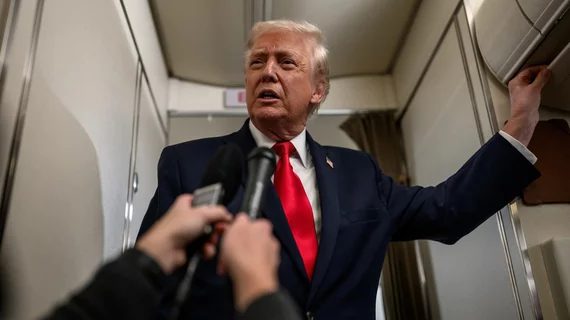
State-level regulation of AI: President Trump has turned his thinking into action.
In an executive order posted to the White House website Dec. 11, the President moves to kick-start the development of a national AI legislative framework. The EO lays out nine imperatives that, working together, aim to “check the most onerous and excessive laws emerging from the States that threaten to stymie innovation.” It doesn’t name-check any particular industries but, instead, touts the Administration’s efforts to “encourage adoption of AI applications across sectors.”
- One of the action items involves the formation of an AI litigation task force. Here President Trump calls on Attorney General Pam Bondi to set up a group charged with challenging state AI laws that “unconstitutionally regulate interstate commerce, are preempted by existing Federal regulations, or are otherwise unlawful in the Attorney General’s judgment.” The same action item directs the task force to consult “from time to time” with Administrative Branch officials on “the emergence of specific State AI laws that warrant challenge.” The to-be-consulted officials include the Presidential Advisor for AI and Crypto, that being David Sacks, as well as the Assistant to the President for Science and Technology (Michael Kratsios) and the Assistant to the President for Economic Policy (that’s Kevin Hassett—for now)
- Reaction to the EO has been swift and, in places, pointed—whether pro or con. Here’s a sampling of the brouhaha in early headlines with giveaway angles:
- “Trump Signs Executive Order to Neuter State A.I. Laws” (The New York Times)
- “The White House AI Order Sends the Right Message on Fragmented State Laws” (Center for Data Innovation)
- “Trump Signs Executive Order Blocking States From Enforcing Their Own Regulations Around AI” (CNN)
- “Trump AI Executive Order Targets State Regulatory Overreach To Protect National Markets” (R Street Institute)
- “Trump Signs Executive Order to Neuter State A.I. Laws” (The New York Times)
HHS’s new plan for AI adoption sends a clear signal to industry: ‘Show us what you can do.’
That’s the take of a global law firm that has digested the contents of the strategy document, released Dec. 4, and seems to have cogitated on it before weighing in. The plan “lays the foundation for external partnerships,” remarks Holland & Knight in a blogpost authored by the firm’s D.C.-based public affairs advisor, Sarah Starling Crossan. Further, she notes, the HHS strategy advances the agency’s desire to collaborate with private-sector innovators who can help “amplify AI’s benefits in health and human services delivery.”
- The strategy document suggests a decisive shift in how HHS approaches AI, Crossan believes. It “aims to rid the agency of a fragmented collection of isolated pilot projects and establish coordinated AI capability,” she adds. “By aligning with previous AI documents out of the Trump Administration and laying out clear responsibilities, HHS aims for an AI innovation-forward agenda for the coming years.” HHS also uses the plan to position itself as a muscular mover determined to make America healthy again, she writes, albeit not in so many words. Not least, Crossan concludes, the document helps cement HHS’s reputation as an AI leader in U.S. healthcare’s drive to “deploy [AI] rapidly and with a clear focus on patient outcomes.”
- Hear out Holland & Knight via spokesperson Crossan here.
AI will never be perfect, but we can live with many if not most of its mistakes.
Should we do that, though—even in healthcare? No, argues a professor of innovation. The good news is that we don’t have to.
- “A doctor could certainly use AI to decide potential drugs to use for different patients, depending on their medical history, physiological details and genetic makeup,” writes Carlos Gershenson, PhD, of SUNY’s Binghamton University. “But common sense and the precautionary principle suggest that it is too early for AI to prescribe drugs without human oversight. And the fact that mistakes may be baked into the technology could mean that where human health is at stake, human supervision will always be necessary.”
- A concise and sensible take. Get the rest of it.
Also worthwhile:
- Mass General Brigham announces new AI company to accelerate clinical trial screening and patient recruitment (MGB)
- Where to invest in AI in 2026 (Bloomberg)
- NAACP calls for equity-first approach to AI in healthcare, issues governance framework to build healthier futures (NAACP)
From HealthExec’s sibling news outlets:
- AI’s biggest return on investment currently comes in the form of time (Radiology Business)
- AI-powered FFR-CT software linked to considerable cost savings, accurate predictions (Cardiovascular Business)

Dave P. has worked in journalism, marketing and public relations for more than 30 years, frequently concentrating on hospitals, healthcare technology and Catholic communications. He has also specialized in fundraising communications, ghostwriting for CEOs of local, national and global charities, nonprofits and foundations.