
Evaporation of Great Salt Lake could bring $2B a year in costs to Utah healthcare system, study finds
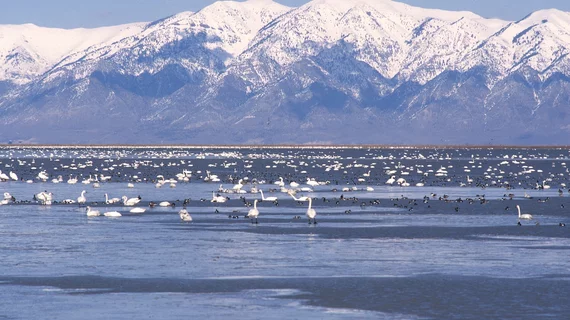
As the Great Salt Lake in Utah dries up and leaves a dusty wind behind, a nonprofit looking at the impacts of the change found that it could drive up healthcare costs to the tune of $2 billion a year.
Those costs, according to the lead author of the study, Lena Harris, an assistant professor at Texas A&M University, come from air pollution and water needs alike, as a debate in the state about ways to refill the lake are ongoing.
The unique salty characteristics of the lake mean dust sediment is potentially harmful to public health, blowing particles of earth that contain—among other naturally occurring elements—arsenic into the air, which people then breathe into their lungs.
Working on the study for the National Bureau of Economic Research, the authors said they expect trips to the emergency room and chronic illnesses from air pollution to rise, as hospitals also face larger water bills as new supplies are put into place.
According to their findings, the shrinking Great Salt Lake could mean the public faces an additional $1.1 billion to $2.3 billion in healthcare-related costs every year. That, they believe, outweighs the expense of putting water back into the lake, thus mitigating the damage from dust pollution.
As the lake erodes, associated healthcare costs will only go up, the study authors wrote.
“Marginal annual costs range from $81 to $175 million per 100 km² of exposed lakebed. Scaling to the area of total exposed lakebed, annual desiccation-related health cost estimates range from $1.1 billion to $2.3 billion,” Lena et al. wrote. “Given the direct relationship between human water use in the basin and exposed lakebed, these results provide evidence for the cost-effectiveness of policies aimed at reducing consumptive water use.”
More dry lake, more problems
For every 39 square miles of the lakebed that ends up exposed to the air, fine particulate matter less than 2.5 micrometers in diameter—which is most harmful to humans—increases exponentially. If the study authors’ projections are correct, exposure to microscopic particles—which enter the lungs—will only increase over time, and could impact a radius of up to 62 miles from the dry lakebed.
In terms of finding a new source of water, the researchers wrote that they project it will carry a cost of $432 to $975 per acre-foot, further burdening the public.
By reducing the dust, the study calculated that Utah could save between $600 and $1,800 a year, per additional acre-foot of water that refills the Great Salt Lake. In other words, saving the lake may not be a requirement of reducing costs—all it would take is more water entering the lakebed.
The Great Salt Lake is the largest saltwater lake in the U.S. and the entire Western hemisphere.
For more, read the full paper “Dust in the Wind: The Health Costs of Great Salt Lake Desiccation” by clicking here.

Chad is an award-winning writer and editor with over 15 years of experience working in media. He has a decade-long professional background in healthcare, working as a writer and in public relations.