
Dying former US senator: ‘Will AI bring heaven or hell? Yes.’
.jpg)
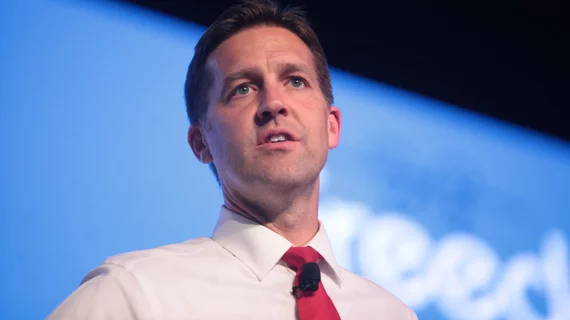
Ben Sasse is showing the effects of the terminal pancreatic cancer he was diagnosed with late last year. The harsh treatments he’s been undergoing to extend his life are taking their toll too. The 54-year-old’s face oozes blood. He’s clearly lost weight.
Yet the former Nebraska senator and two-time university president is still in good spirits and his mental energy remains high. What’s more, he’s still thinking rigorously about the future—and not just because he will leave behind a wife and three kids when he goes. Always a freethinker unafraid to speak his own mind, Sasse is now more candid than ever with his thoughts about life, death, faith, family, education and, yes, politics.
All of this comes across in a video interview bracingly conducted by Ross Douthat of The New York Times.
In an hourlong video of the session, Sasse’s sage thoughts on AI come across as worthy of consideration by all watchers of the technology.
Here are excerpts from Sasse’s responses to Douthat in a segment specifically focused on AI.
‘Do [I] think AI is going to bring heaven or AI is going to bring hell? The right answer is: Yes.’
“AI is going to be human activity and behavior at warp speed for good and for ill. A lot of the stuff that we’ve been good at, we’re going to get more of it—faster, cheaper and more broadly distributed. But a lot of what’s horrible about human addictions and distractions, we’re also going to get a lot more of it faster, cheaper more ubiquitous.”
‘I think the grand divide that is coming [with AI], sociologically or demographically, is not chiefly a class divide.’
“I think the grand divide that’s coming is about intentionality and what you do with your affections and these supertools. The people who use the tools and get to capture the ability to drive marginal computing costs toward zero, we’re either going to make the quantification of routinizable tasks either actually free or so close to free that we won’t bother to meter it anymore—that’s going to be extraordinary. It’s going to be a transformation of the way economics has worked for human history.”
‘Past economics was a discipline about scarcity. [In the age of AI], economics is going to become a discipline about ubiquitous abundance.’
“Or your people who agree to outsource your attention and affections to somebody else’s algorithm—that’s hell. Who would’ve ever thought that we’d be living in a sex collapse—less premarital sex, less extramarital sex, less marital sex—because people are so addicted to not just pornography proper, but digital distraction from bodily goodness? That’s weird. And I think the digital revolution that we’re going to live through is going to bring all of that at a faster speed.”
‘For a small number of people with lots of intentionality, these [AI] tools are probably going to be pretty great.’
“For the majority of people, I think they’re going to be disastrous. … Our temptation to allow these tools to algorithmically tempt [us] into an eternal now now now now now now slot machine of dopamine hits is super dangerous.”
‘[Young people] deserve the benefits of 80-year-old wisdom.’
“And 80-year-olds deserve the benefits of the reward of seeing 16-year-old vitality again. We have been, for 150 years, tempted toward generational segregation, which loses wisdom. One of the things I think the digital revolution does is it takes our generational segregation and puts it on speed, and we lose lots of wisdom. We need a lot more communitarian thickness to get at some of these self-restraints and self-controls [so] that [we] can use the tools instead of being used by the tools.”
In places Sasse’s cheerful answers to Douthat’s pointed questions are both moving and inspirational. The whole thing is well worth a watch.

Dave P. has worked in journalism, marketing and public relations for more than 30 years, frequently concentrating on hospitals, healthcare technology and Catholic communications. He has also specialized in fundraising communications, ghostwriting for CEOs of local, national and global charities, nonprofits and foundations.