
New patient monitoring model draws scrutiny
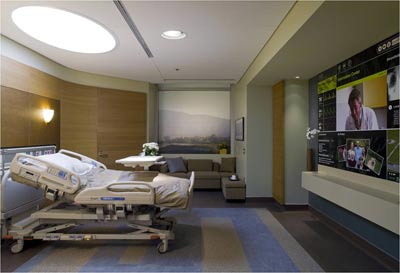 | |
| PMC West room mockup |
At issue are the beds: PMC West intends to provide acuity adaptable beds for patients, enabling them to receive different levels of care without leaving their hospital room. These beds will be ICU licensed, but not all the patients will receive ICU care. And this is illegal in California and many other states.
Currently under construction with plans to open its doors in June 2012, PMC West will include two 11-story towers and a maximum capacity of 450 beds (although it will open with 289 beds). It will be part of the Palomar Pomerado Health (PPH) system, which includes 319-bed Palomar Medical Center in Escondido and 107-bed Pomerado Hospital in Poway.
The facility, two connected towers, will have a floor plan that attempts to reduce errors and improves the health of patients through an evidence-based design approach along with acuity-adaptable rooms, said Benjamin Kanter, MD, CMIO of PPH. In most healthcare settings, patients are moved between units as they receive care. However, acuity adaptable rooms enable patients to receive care in one location, which can eliminate transitions--and thus, potential errors.
“Our vision for the new medical center is that once you enter, you are remotely monitored throughout your stay,” said Kanter. “The question is: How do you allow mobility and noninvasive monitoring practices while maintaining nursing ratios? It’s a difficult vision where everyone has that safety net of continuous care that is cost effective.”
Included in the floor plan are healing gardens on every floor and localized drug distribution machines that keep medications and other necessities close to patients no matter where they are, to reduce “hunting and gathering,” Kanter said. The West tower, designed to be acuity adaptable, will include intermediate care (IMC) to ICU care levels; the East tower will be a medical surgery building with conventional general medical/surgery to IMC ratios, Kanter said.
Using an acuity adaptability practice model, the patient is assigned to a bed or room based on his or her critical need and is not transferred as the level of care changes. In a traditional practice model, patients can be transferred up to six times in a four-day length of stay, said Lorie Shoemaker, chief nurse executive at PPH.
“Every time you move the patient, you introduce the potential for medical error. If you can keep the patient in the same room and bed while changing the nursing model, you’ve eliminated at least one facet of care that is problem prone.”
PMC West’s acuity adaptability beds will be built to meet licensed intensive care requirements, but patients at all levels of acuity will be assigned to those beds throughout their care, according to Shoemaker. The nurses caring for the patient will change as acuity changes. The intent of the model is to match the skills and competencies of the nurse with the acuity of the patient such that critical care nurses take care of critically ill patients, Shoemaker said.
However, the acuity adaptable care model is not legal in California. According to Title 22 from the California Department of Public Health, any patient in a licensed intensive care bed must be critically ill and every critically ill patient must be in a critically licensable bed. “The bed and the patient acuity must match,” said Shoemaker.
States including Ohio, Indiana, Hawaii, Arizona and Washington currently include acuity adaptable capabilities in their respective state laws, according to Shoemaker, and the 35-year old Title 22 in California is due for an overhaul to keep pace with changes in technology and/or care delivery models.
“ICU patients have more intensive needs than med/surg patients, so the rooms need to be bigger, have more oxygen and medical gas outlets, and be positioned such that the head of the patient can be seen from the nursing stations,” said Shoemaker. “In theory, Title 22 is meant to ensure the patients get the highest level of care; however, it is old and outdated,” she added.
Shoemaker has been working on a legislative proposal for a pilot program to test the model in a three- to five-year period at PMC West, in hopes that results will prove the model leads to better patient care and outcomes. However, during the last legislative session, the pilot program faced challenges in the Assembly Health Committee due to opposition from the Service Employees International Union (SEIU) and more recently from the California Nurses Association.
SEIU wanted to be sure that all unions in a hospital participating in the pilot project would be consulted prior to undertaking the study; a provision made in the revised bill that Shoemaker plans to reintroduce this legislative session by the end of April.
Shoemaker reports that many hospitals are interested in building acuity-adaptable rooms in California, but “no one is working to change the law.” If Title 22 is not been changed by the time PMC West opens its doors, the team will activate “Plan B,” Shoemaker said.
“PMC West is estimated to need 72 intensive care beds by 2015,” said Shoemaker. “On day one, we will open with 168 medical/surgical beds, 120 acuity adaptable beds. If Title 22 is not changed by that day, then we will license 72 of those 120 acuity adaptable beds as intensive care unit beds and the rest as medical/surgical beds.”