
Gen Z seems to appreciate TikTok doctors more than the ones seen in person
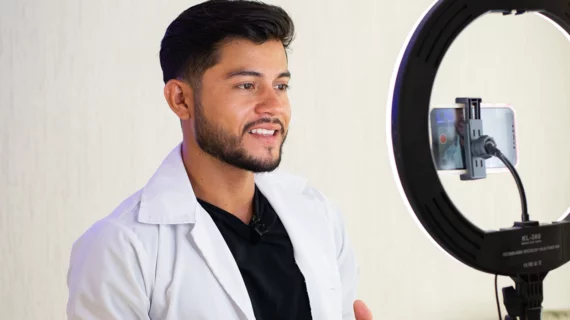
Many young people between 14 and 29 years old are getting health advice from physicians who double as social media influencers (SMIs) on the TikTok platform.
In fact, these members of Generation Z don’t even seem to mind if their favorite TikTok docs are not, in fact, credentialed healthcare professionals.
As long as the influencer presents with apparent knowledgeability, a polished appearance, medical accoutrements and a caring demeanor, he or she will probably be afforded plenty of leeway to hold forth on all things health and healthcare.
These are among the findings of a study conducted at Virginia Commonwealth University and published Sept. 22 in the Journal of Consumer Affairs.
Suzanne Makarem, PhD, MBA, and colleagues further found the halo effect—produced by what they call “mere social media presence”—holds firm even when the influencer has something to sell.
And in many cases, it causes hooked Gen Zers to prefer their SMI doctor over their own.
In the real world, doctors “just want to see you again,” one Gen Z participant told the researchers, implying non-SMI physicians deserve suspicion of financial motives. By comparison, healthcare providers on TikTok “tend to tell you steps to take and things to do” to prevent your condition from coming back:
“TikTok doctors have no [financial] interest in seeing you again.”
Gen Zers in their own words
For the study, Makarem and co-researchers analyzed 330 TikTok videos. They concentrated on 11 U.S.-based, licensed physicians who have substantial followings and engagements on TikTok.
The team also interviewed 26 Gen Z “informants” who actively follow physician-influencers.
The study report offers numerous observations supported by direct quotes from the Gen Z informants. Among them are these five standout excerpts.
1. When asked about how they know that the physician SMIs they follow are authentic board-certified physicians—as opposed to fake experts—Gen Zers tend to note visual cues like medical attire, background and/or props.
Gen Z informant:
‘Even in her videos at home, she always has a stethoscope on and all this stuff, which to me makes it look like you’re more of a doctor.’
2. Visible cues of professionalism matter.
Gen Z informant:
‘In some of his videos, he’ll have a skeleton he uses, and he will actually point to the parts of your back that he is trying to help. He’ll tell you where you’re feeling pain, what parts of the spine [are affected] and everything. You can tell he actually knows what he’s talking about.’
3. Gen Zers tend not to view physician-SMIs as engaging in self-promotion or advertising—even when the SMIs are endorsing products.
Gen Z informant:
‘I do feel like they are trying to promote themselves, but it’s not all about the money at the end of the day. They do care about helping people. If everything was free in the world, they’d probably do it for free. But everything does cost money, and they have a family to support. … I truly believe they are trying to make a difference in the world.’
4. Gen Zers tend to perceive a physician’s presence on social media as a signal of benevolent intentions to help, to educate and to motivate.
Gen Z informant:
‘I think they’re good doctors … They’re accessible … They are on social media giving out their knowledge to others.’
5. When asked whether they checked the licensure or board certification of the physician SMIs they follow on TikTok, all 26 informants in the sample said no—and defended their assumptions.
Gen Z informant:
‘I’m pretty sure that Doctor [TikTok name of doctor] is actually a licensed surgeon. OK, I could be wrong on that, but I’m pretty positive on that. I did not [look it up], that’s based on assumption, if I’m being totally honest.’
In the university’s own coverage of the study, Makarem says Gen Zers turn to social media for health information at “significantly higher rates than previous generations. TikTok has emerged as especially influential for health information.”
She also comments on the “mere social media presence” effect.
“What a physician-influencer recommends may carry more weight than what their own doctor tells them,” Makarem says. “That should give us pause.”
The study is posted in full for free.

Dave P. has worked in journalism, marketing and public relations for more than 30 years, frequently concentrating on hospitals, healthcare technology and Catholic communications. He has also specialized in fundraising communications, ghostwriting for CEOs of local, national and global charities, nonprofits and foundations.