Paramedics, flight nurses become experts in trauma care by hands-on experience, not long careers per se
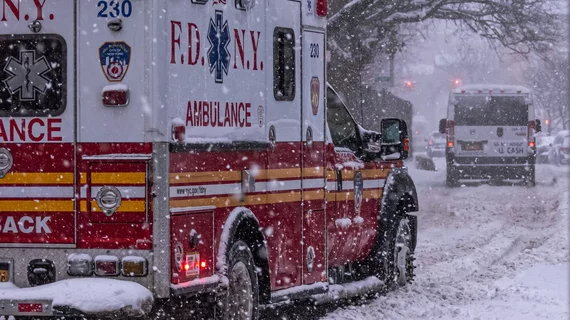
Severely injured patients fare best when they’re initially treated by EMS clinicians who have seen a lot of trauma.
By comparison, EMS colleagues with many years on the job but not much direct trauma exposure set the stage for less impressive patient outcomes.
The findings are from a study conducted at the University of Pittsburgh School of Medicine. JAMA Surgery published the research Feb. 18.
Senior author Joshua Brown, MD, MSc, and co-investigators analyzed data on 6,769 patient-clinician interactions involving 359 clinicians and 3,649 patients.
The latter were patients transported to a trauma center by air or ground ambulance with injury severity scores ranging from moderate to life-threatening.
The clinicians were 235 paramedics and 124 flight nurses.
Brown and co-authors report they found “higher prehospital individual clinician trauma patient volume” corresponded with lower mortality and faster scene time.
Scene time refers to how long it takes for first clinical responders to depart with the patient after arriving on the scene.
Practice perfects EMS professionals
The researchers also found the most marked positive effects—recoveries, essentially—occurred in patients who were at high risk of succumbing and were treated by EMS professionals whose backgrounds included large trauma volumes.
“Nontrauma volume and years of experience are inadequate substitutes for trauma volume when caring for injured patients,” Brown et al. remark in their discussion section.
“These results can inform EMS performance improvement and benchmarking,” they add, “and innovative approaches are necessary to leverage this volume-outcome association to improve prehospital care for injured patients.”
‘Making high-stakes trauma decisions really matters’
In coverage of the study by UPMC’s news operation, Brown suggests the results surprised the researchers.
“You might assume that someone who’s been a paramedic for 20 years would automatically have better outcomes,” he says. “But what we found is that trauma is different. Seeing more trauma patients more often—recognizing those patterns and making those high-stakes decisions—really matters.”
Translating research into life-saving EMS response
The team offers four strategies that healthcare leaders and municipal governments might build or refine from the present research:
- Develop national EMS quality benchmarking programs similar to those used by trauma centers.
- Use AI to help build staffing models that avoid pairing low-volume EMS clinicians together.
- Expand the use of simulation, virtual reality and other training tools to supplement real-world experience.
- Create mentorship partnerships between high- and low-volume EMS agencies.
“Supporting EMS funding, training and innovation at the community and policy level is how our findings translate into saved lives,” Brown says.
The journal study is here.

Dave P. has worked in journalism, marketing and public relations for more than 30 years, frequently concentrating on hospitals, healthcare technology and Catholic communications. He has also specialized in fundraising communications, ghostwriting for CEOs of local, national and global charities, nonprofits and foundations.