
Hospitals accounted for 40% of spike in healthcare spending, far more than any other category: KFF

National health spending is increasing rapidly, hitting $5.3 trillion in 2024, accounting for 18% of GDP in the U.S. As it’s projected to rise further, hospital expenditures are leading the increase in overall dollars, accounting for 40% of the increase from 2022 to 2024, a study from KFF found.
Released earlier this month, the nonprofit research group’s report was developed after looking at the higher prices faced by Medicare, Medicaid, private insurers and out-of-pocket expenses for families, attempting to pinpoint the primary drivers of rising price tags.
KFF noted that, at the beginning of 2025, insurance premiums—which is largely an indicator of how expensive it is for most Americans to access healthcare—jumped to record levels, with employers now paying an average of $26,993 for family coverage and those same families paying $6,850 for their medical benefits.
Those results, KFF noted, came from its annual survey of employers released in Oct. 2025. This new report is examining the factors contributing to rising costs.
Zooming in on the primary driver, an analysis of public data from the Centers for Medicare & Medicaid Services (CMS) National Health Expenditures Accounts (NHEA) showed that hospitals were the biggest factor.
In total, hospitals—including outpatient services and emergency care—accounted for one-third of all healthcare expenditures nationally in 2024, more than doubled over the last two decades. In terms of specifics, that’s a $277 billion spike, or 40% of all increased healthcare-related spending in the U.S.
“The large contribution of hospital care to overall health spending growth reflects the fact that hospital spending accounted for nearly a third of national health expenditures in 2022 (30%) and grew more quickly than national health expenditures overall in both 2023 (10.6% versus 7.4%) and 2024 (8.9% versus 7.2%),” KFF wrote.
The nonprofit noted that CMS said, as quoted, that the increase between 2023 and 2024 may have been a result of “rebound in nonprice factors, such as the use and intensity of services, that were somewhat depressed during the [COVID-19] public health emergency.”
However, KFF noted that delayed services are only part of the picture. Prices for services grew by 2.7% in 2023 and 3.4% in 2024. According to the study authors, CMS data showed this was the biggest increase on record since 2007.
“Hospital price growth includes Medicare and Medicaid as well as commercial prices; hospital prices in these public programs have grown more slowly than commercial prices over time,” KFF clarified.
Physician care and cost of drugs also driving up prices
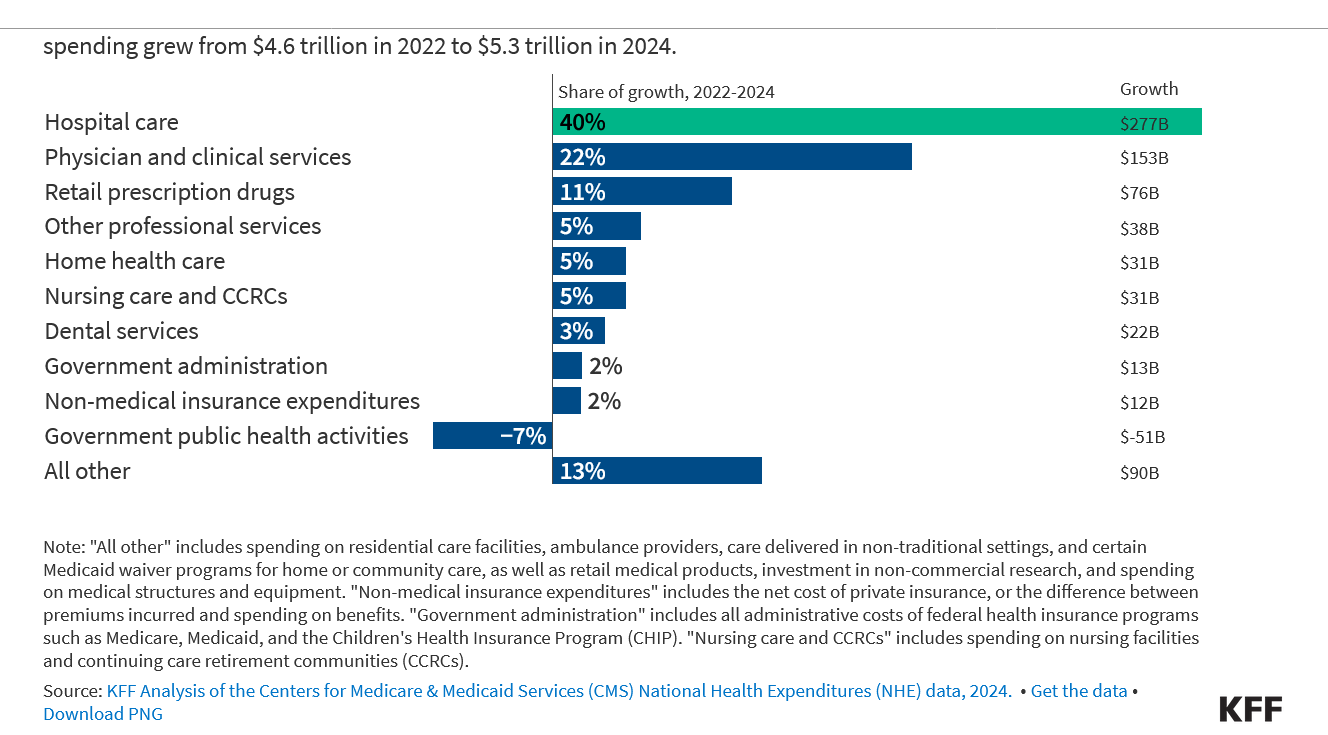
As shown in the graph above, other categories of healthcare spending did not have the same weight as that of hospitals. Physicians and clinical prices, the second-largest share, accounted for 22% of all growth nationally, followed by retail prescription drugs which hit in totality 11% of all growth in national spending from 2022 to 2024.
“Spending on non-medical insurance expenditures, other professional services, home health care, nursing care and continuing care retirement communities, dental services, and government administration accounted for smaller shares. Spending on government public health activities declined by 7% during this period, likely due to the winding down of activities related to the COVID-19 pandemic,” KFF added.
All other services combined—including long-term patient care—accounted for only 13% of the overall growth in national spending, according to the report.
KFF’s full analysis is available by clicking here.

Chad is an award-winning writer and editor with over 15 years of experience working in media. He has a decade-long professional background in healthcare, working as a writer and in public relations.