
5 takeaways from Dr. Wachter’s ‘Giant Leap’ with AI in healthcare
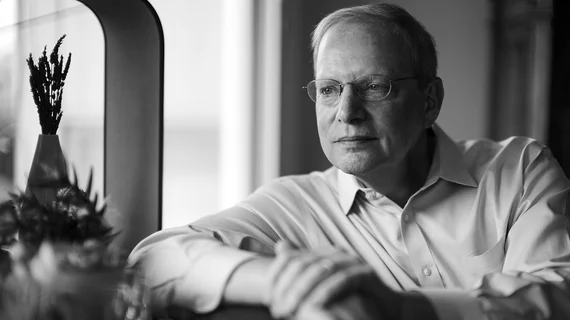

Someday the computerization of medicine will be recognized as the game-changing, paradigm-shifting, everything-upending “disruptive innovation” that so many healthcare watchers and stakeholders have been waiting for. “Today,” however, “it’s often just plain disruptive.”
Eleven years have passed since Robert Wachter, MD, made that wry observation in his bestseller The Digital Doctor: Hope, Hype and Harm at the Dawn of Medicine’s Computer Age. This month he more or less picks up where he left off.
The new surefire thought-provoker/conversation-starter is Wachter’s A Giant Leap: How AI is Transforming Healthcare and What That Means for Our Future. Penguin Random House sent it to market Feb. 3. It’s already No. 1 in Amazon’s computers & technology category.
Wachter’s day job remains professor and chair of the Department of Medicine at the University of California, San Francisco (UCSF). HealthExec has read the new book and highlighted favorite passages. If we shared them all, this would be a very long read in its own right. Instead, for the sake of conscientious brevity, here are five Giant Leap passages that work as standalone points to ponder.
1. For at least the next decade, most AI systems in healthcare will fall between two extremes.
They’ll be right often enough to be useful and wrong often enough to not be entirely trusted. “This means that patients will increasingly receive care based on AI systems that bake in a physician’s signoff as the final step. Sounds perfect, right? Not completely,” Wachter writes. “The first problem is this: Humans are very good at many things, but vigilance is not one of them, particularly when it comes to monitoring the output of generally reliable technologies.”
More:
“The second problem is de-skilling. As humans are called upon less often to exercise a particular cognitive muscle, their skills will degrade, and so will their capacity for robust double-checking. I generally don’t remember my wife’s cell phone number—I fear I might never see her again if I lose my phone. And does anybody know how to read a map anymore?”
2. The most profound long-term effect of healthcare AI may be on patients.
Generative AI is already equipping patients to manage their own health—and in ways prior generations would not have imagined, Wachter points out. It’s doing so “both by enhancing their interactions with traditional healthcare services and, in some cases, allowing them to meet their medical needs without involving the healthcare system at all,” he writes. “Yet the trajectory is unmistakable.”
More:
“AI’s entry into healthcare is arming patients with unprecedented knowledge and capabilities. While health-literate, tech-savvy people are at the vanguard of this transformation, they represent just the beginning. Soon millions of patients will be using AI to break down traditional barriers and create a far more democratized healthcare system.”
3. We’re in the midst of a crisis in primary care.
Concierge-level service for everyone would be the ideal solution—but healthcare economics make this impossible, Wachter writes. The vast majority of patients can’t afford concierge services, he points out. For them—and, by extension, for the U.S. healthcare system as a whole—access to quality primary care remains a critical gap.
“AI will undoubtedly play a role in addressing this challenge,” he forecasts. “However, without accompanying reforms in payment and policy—including incentives for preventive care, competitive compensation to attract new physicians to primary care, and sustainable patient panel sizes and visit durations—technology alone won’t solve this problem.”
More:
“While [AI] won’t be the entire solution, I am convinced [the technology] will play a key role in addressing our primary care crisis. In fact, I predict that our future system for delivering primary and urgent care will involve a different kind of tiering—not between usual and concierge care but between usual and AI-enabled care.”
4. Here’s hoping the new AI will usher in digital healthcare’s ‘gradually, then suddenly’ moment.
Wachter believes that hopeful moment is upon us right now. “My optimism isn’t only because the AI has improved dramatically since ChatGPT’s November 2022 debut—although it has,” he writes. “It’s mainly because clinicians and healthcare organizations are implementing these tools thoughtfully and beginning to see tangible, positive results. Some patients are too.”
More:
“While concerns about AI being deployed too rapidly are justified when it comes to society at large, healthcare’s natural guardrails—our professional risk aversion, powerful incumbents, spring-loaded malpractice system, byzantine payment structures and stringent privacy rules—produce ample amounts of brake-tapping. These constraints have created a healthy equilibrium—one in which we are gaining comfort with AI while implementing only reasonably well-vetted tools built by companies we trust.”
5. Geoffrey Hinton, the ‘Godfather of AI,’ got it wrong in 2016 when he famously predicted the imminent downfall of radiologists at the hands of AI.
That said, Wachter acknowledges, the threat of job replacement is real in every sector of the economy. “Over the next several decades, in a world of driverless cars, it would be naive to claim that autonomous AI has no place in healthcare,” he warns. “Eventually, AI’s productivity gains will outpace healthcare’s growing needs, which will result in some clinical roles being displaced by technology. Yet when I’m asked if I would encourage a child to pursue a career in medicine—and I get this question often—my answer is an emphatic yes.”
More:
“I’m convinced that AI will lift many of the bureaucratic burdens that weigh down today’s medical practice, allowing us to rediscover what makes medicine profoundly satisfying: the privilege of helping people when they’re most vulnerable.”
Amid the complex employment considerations raised by AI and described in this new book and elsewhere, Wachter adds, “we must remember a fundamental truth: Healthcare’s primary purpose isn’t to provide jobs—it’s to maximize human health.”
The book is listed in hardcover for $32 at the publisher’s promo page, which also presents links to retailers offering discounts.

Dave P. has worked in journalism, marketing and public relations for more than 30 years, frequently concentrating on hospitals, healthcare technology and Catholic communications. He has also specialized in fundraising communications, ghostwriting for CEOs of local, national and global charities, nonprofits and foundations.