
The future of hospital logistics is with AI
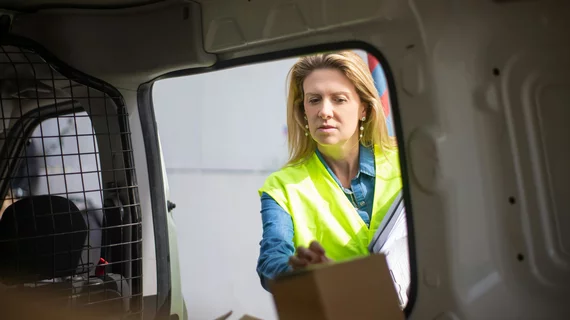
In hospital settings, the success of AI adoption hinges on how well implementation leaders balance technological innovation in departmental silos with operational nimbleness across the enterprise.
In a term, the latter refers to hospital logistics.
The observation is from researchers at the Fraunhofer Institute for Material Flow and Logistics in Dortmund, Germany. Their paper was published July 15 in the German journal Federal Health Gazette: Health Research/Health Protection (Bundesgesundheitsblatt: Gesundheitsforschung/Gesundheitsschutz).
The work “contributes to understanding the potential and limitations of AI applications in hospital logistics and provides a systematic framework for their strategic implementation,” state the authors, Sylvia Kaczmarek, PhD, and Sebastian Wibbelin, PhD, both of whom are Fraunhofer engineering professors.
The researchers walk the reader through a number of hospital settings in which AI-aided logistics are either already active or soon will be. Here are three.
1. Transport.
In conventional autonomous transportation, robots with decentralized control mechanisms enable intelligent resource utilization through swarm-intelligence behaviors and optimized order scheduling, the authors explain. “These systems use machine learning algorithms to recognize patterns in data and make decisions in real time, which significantly increases the efficiency and speed of transportation (intelligent routing, avoidance of empty runs, use of available elevators, etc.).” More:
‘Transport robots with AI-enabled sensor boxes—which are currently in the development phase and take up the basic idea of innovative logistics approaches—go a step further. With them, autonomous vehicles can learn from human interventions during transport disruptions and predict similar situations in the future.’
2. Central warehouses and pharmacies.
In warehouse logistics, AI can enable predictive planning approaches that take dynamic influencing factors into account, Kaczmarek and Wibbelin point out. “Furthermore, they offer flexible response options to unexpected events.”
For example, the authors add, AI-supported systems can analyze historical data to predict future demand and adjust inventory levels, thereby improving resource availability. “In picking processes, AI can predict likely quantities per cost center, making the use of transportation resources more efficient.” More:
‘With the advancement of technology, AI-supported picking and transportation technology, especially autonomous robot systems, is expected to become increasingly established. These systems optimize material flow processes within various organizational units and contribute to increasing overall productivity.’
3. Nursing stations.
In bed-based areas such as nursing and intensive care units, AI opens up innovative possibilities for optimizing material management and logistics processes, the authors note. “AI-supported analysis of material consumption data,” they write, “enables precise predictions for optimal storage and ordering quantities.”
What’s more, the authors highlight, AI “offers the potential to automatically detect and document nursing activities through motion identification using sensors. This not only improves the traceability of care services but also relieves nursing staff of documentation tasks.” More:
‘Logistics processes in nursing stations can also be supported by autonomous robot systems. These systems can efficiently transport materials, medications and laboratory samples between different hospital areas—for example, between the intensive care unit and the laboratory.’
The paper is posted in full for free, albeit in German. AIin.Healthcare used OnlineDocTranslator.com to render the text in English.
- In other research news:
- Pusan National University: Researchers develop game-changing method to create safer, long-lasting lithium-ion batteries
- Weizmann Institute of Science: Meet your digital twin
- Royal College of Surgeons in Ireland: Researchers develop 3D printed implant to help heal spinal cord injuries
- Pusan National University: Researchers develop game-changing method to create safer, long-lasting lithium-ion batteries
- Funding:

Dave P. has worked in journalism, marketing and public relations for more than 30 years, frequently concentrating on hospitals, healthcare technology and Catholic communications. He has also specialized in fundraising communications, ghostwriting for CEOs of local, national and global charities, nonprofits and foundations.