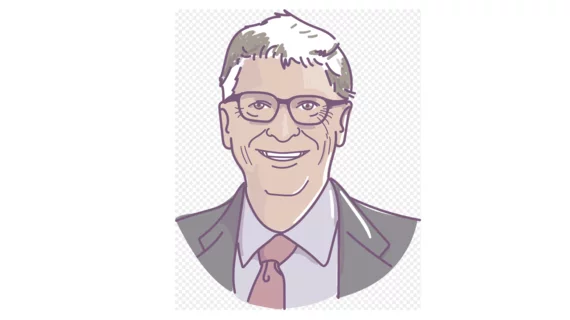
When Bill Gates talks world-changing technology, people listen. Have you heard what he’s saying about AI in healthcare?
“Bill Gates warns ‘there is no plan’ for the ‘upheaval’ AI will cause.” … “Bill Gates says AI will either be ‘greatest equalizer’ or ‘worst source of injustice’” … “Bill Gates is deeply worried about AI—and he’s no longer staying quiet” …
These are just three of countless headlines that popped in the 24 hours after the business magnate, Microsoft co-founder and longtime (albeit former) face of the brand blogged on the current state and future outlook of artificial intelligence.
More specifically, Gates did a deep dive into his personal hopes and fears around the technology.
Perhaps unsurprisingly, it’s the fears that have found the most traction with the press.
Be that as it may, here are seven of Gates’s key passages dealing with healthcare AI as found in the Aug. 26 post, which is headlined “The turbulent AI era is here. The choices we make now are critical.”
1. Imagine a robot giving you the awful news that you have an incurable disease. There’s no technical reason why it couldn’t. Yet it shouldn’t.
‘A domain called Human Reserved will evolve over time. We should consider setting aside some jobs now and phasing in AI slowly over years or decades with a commitment to preserve some jobs. Some areas, like education and mental healthcare, will be a mix, with a human in charge who’s using the technology to extend what they can do.’
2. Solutions should be developed through a public democratic process that includes elected officials, policymakers, educators, health workers, local officials and community leaders.
‘Millions of people will have their lives disrupted, and we’ll need a stronger, more flexible social safety net to help them manage the transition. Local communities are already raising concerns about the energy and water needed for data centers. Without solutions, some groups will push for stopping AI development and deployment altogether.’
3. AI will affect national security as well as employment, education, taxation, energy, elections, air and water, public health, the financial system, law enforcement, transportation, public lands and IT systems.
‘These sectors overlap in ways our existing bureaucracy is not designed to manage. A labor department may understand workforce disruption but not security risk. A business regulator may understand market concentration but not AI’s effects on children and teenagers. Left to themselves, institutions will see only one part of the system, while the consequences of AI will ripple across the entire system.’
4. I’ve met families who, understandably, were overwhelmed by the process of applying for health insurance, student aid or food assistance.
‘Faced with a huge stack of complicated bureaucratic forms, many felt like giving up. AI can streamline things dramatically so they get the help they need faster and the government can operate more efficiently. Governments can make the citizen’s experience far better, starting with those who need its safety net services the most.’
5. Despite my concerns about its impact on our mental health, I think AI can also help a lot there.
‘Most communities have too few counselors, psychiatrists and addiction specialists. With the right privacy safeguards in place, AI tools could help people recognize warning signs. Then, if needed, they can offer evidence-based coping strategies and team up with a human to provide more responsive treatment.’
6. Healthcare is one area where AI can [already] help solve real-world problems.
‘Many small American hospitals lack on-site specialists who can quickly diagnose a patient during a life-threatening emergency. In those places, AI could make sure a heart attack is caught in time and a family avoids the crushing expense of a medical emergency. … AI [can] also help primary-care doctors make better diagnoses and keep in touch with their patients when they’re not in the clinic. It [can] help patients understand test results and complicated schedules for taking their medicine.’
7. The Gates Foundation has 19 years left of the 20 years in which it will spend its remaining $200 billion.
‘AI will help it achieve its ambitious goals by both accelerating the discovery of vaccines and medicines for HIV, TB, malaria, and malnutrition and helping the healthcare workforce and patients know how to use those tools. The foundation’s goals include cutting the number of children who die every year in half again, as was done from 2000 to 2024. All of our work, not just health but also agriculture and education, will take full advantage of AI.’

Dave P. has worked in journalism, marketing and public relations for more than 30 years, frequently concentrating on hospitals, healthcare technology and Catholic communications. He has also specialized in fundraising communications, ghostwriting for CEOs of local, national and global charities, nonprofits and foundations.