
Ambient AI can win big for nursing—as long as executive leadership buys in, stays engaged: Case study conclusion
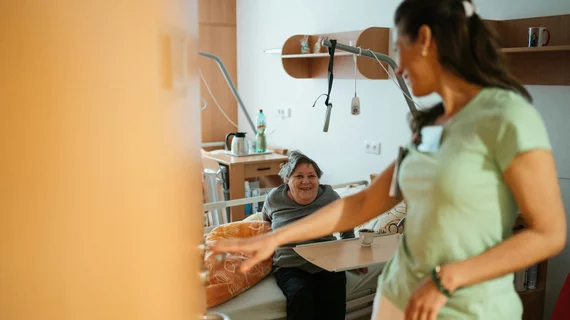
Nursing technology leaders at a large health system are reporting time savings of 20.6 minutes per nurse across 12-hour shifts while caring for an average of 4.5 patients each. The secret to their success: automated digital documentation.
Brian Weirich, DHA, MHA, and former colleagues at Cincinnati-based Bon Secours Mercy Health describe their experience with the technology in a paper published by Nurse Leader April 28. (Weirich is now chief nursing officer at Microsoft.)
Weirich, with co-authors LeAnn Martin, MSN, RN, and Allison Corbin, MSN, RN, analyzed the performance of ambient documentation tools as applied to four workflows. These were daily safety and care checks, fluid balance tracking, standard vital signs and full body (“head to toe”) assessment.
The researchers state the single best performance they observed was a 94% reduction in daily safety and care checks.
Meanwhile their study-wide composite, when extrapolated to a hypothetical system-wide deployment, would translate to 36.3 minutes of time savings per 12-hour shift.
This is “well above the threshold at which ambient documentation shifts from operationally interesting to economically actionable,” Weirich and co-authors comment.
Better still, they add, the worthwhile results required no new technologies to achieve. All it took was “replicating what nurses are already achieving in leading units.”
The gap between those exemplary units and others reflects “a leadership and adoption challenge, not a product limitation.”
Tensions lit and defused
In their discussion, Weirich and co-authors comment on the AI adoption causing a degree of “friction” that extended “well beyond technology.”
“Ambient documentation challenged deeply ingrained documentation habits, role expectations and assumptions about how nursing work should be performed,” the researchers report.
One of the first points of conflict to arise involved the question of making ambient AI adoption mandatory or optional for nurses.
Bon Secours’s system leadership pointedly opted to take the non-optional route, the authors report.
“Just as virtual nursing models are standard components of care delivery rather than voluntary workflows, ambient documentation was implemented with the expectation of consistent use during every patient interaction,” Weirich and co-authors write.
“When that expectation was clearly communicated and supported through training, coaching and visible leadership presence,” they note, “adoption improved and variability decreased.”
Nursing remains ‘inherently human’
The study leaders offer their take on what their experience with ambient AI documentation means for the nursing profession as a whole.
“The question before nurse leaders is not whether ambient documentation provides value but how intentionally they will lead the work required to realize it,” Weirich and colleagues write. “That work is inherently human. It requires leaders who will set clear documentation standards, hold teams accountable and model the behaviors, including narrating care aloud, that make ambient documentation effective.”
What’s more, they maintain, excellent results like those achieved at Bon Secours are not attainable if nurse managers are not “willing to sit with friction and coach through it.”
An essential element, they state, is “executive leadership that sustains visibility beyond go-live and resists the temptation to declare success before adoption has matured.”
The Bon Secours Mercy Health experience with ambient AI for nurses “shows that the gap between average and best-observed performance is not a technology gap,” the researchers underscore. “It is a leadership gap.”
The study is posted here and here (behind paywalls).

Dave P. has worked in journalism, marketing and public relations for more than 30 years, frequently concentrating on hospitals, healthcare technology and Catholic communications. He has also specialized in fundraising communications, ghostwriting for CEOs of local, national and global charities, nonprofits and foundations.