 | ● |  |
|
|
|
| | | News and views you ought to know about:- A battle of words is brewing between Team Trump and CHAI. The former needs no introduction. The latter, regular readers of this newsletter will know, is the Coalition for Health AI. In recent days the two sides have been speaking up to set each other straight.
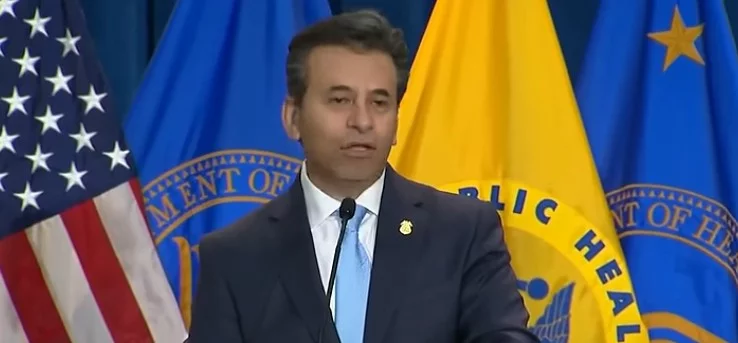
- “Imagine what would happen if the government put Boeing in charge of airline safety, or if fast-food chains set national nutrition standards,” write FDA Commissioner Marty Makary, MD, and HHS Deputy Secretary Jim O’Neill in a piece published by the Washington Examiner. “Such an irony took place when then-President Joe Biden allowed an ‘independent’ nonprofit group backed by Big Tech to regulate, and stifle, the development of artificial intelligence.” The group of which they speak is none other than CHAI.
- CHAI CEO Brian Anderson doesn’t refute the characterization so much as he deflects it. “CHAI has nothing to do with government regulation. The government decides on policy and regulation, and CHAI, we will adapt to that,” Anderson has said. “[But] in a public-private partnership, we want ideally to inform our regulators and our policymakers so they make informed regulations.”
- Other stakeholders have weighed in, taking one side or the other, and Gizmodo posted a nice recap and roundup Oct. 7.
- The ARiSE network launched last year to check the scientific validity of clinical AI models. It’s now matured enough for an outside observer to take its measure. Sai Balasubramanian, MD, JD, does just that for Forbes. Emphasizing that ARiSE is backed by academic heavyweights Stanford and Harvard, the physician-attorney seems to have grown from a dispassionate watcher to an excited fan. ARiSe, Dr. Sai writes, “has been able to produce groundbreaking and industry-moving work,” all of it geared toward answering one simple question: Can AI safely reason like a doctor in real-world care?
- Balasubramanian describes several examples of inarguably outstanding research led by the network, then notes: “Despite how quickly the field of model evaluation is growing, the most crucial aspect of ARiSE is that it has no intention of being commercial in nature; rather, it intends to stay independent and objective.” Why is this so important? Because LLMs and other kinds of AI have outgrown proof-of-concept exercises. Indeed, the technology has “reached somewhat of a critical mass. [M]odels are now being actively pursued and employed in actual, clinical scenarios which are often wrought with critical patient-care decisions.” Read the rest.
- Doctors can fail us. AI could save lives. That juxtaposition of irrefutable statements makes up the subhead of a new book titled Dr. Bot. The author is Charlotte Blease, PhD, a health informaticist at Sweden’s Uppsala University, a researcher in digital psychiatry at Harvard and a respected philosopher of medicine. Laying out her qualifications for, and interest in, writing the book, Blease states in her introduction that she wrote with “a splinter of ice in the heart.”
- “A fair, nonpartisan yet patient-centric perspective is vitally important to present an accurate appraisal of the present and future state of medicine,” Blease clarifies. “Identifying what technology does well and where it currently misses the mark—the tasks it currently excels at, ore even surpasses humans on, and vice versa—requires an impartial vantage point. I am afforded a luxury that very few doctors enjoy: the opportunity to take a step back and offer fresh insight.”
- Commenting on the work Oct. 7, Washington Post columnist Leana Wen says the book raises important questions. “[T]echnology can expand access, but are we comfortable replacing the human element of care? AI can improve disease detection, but how will it help if patients still can’t afford treatments?” And as Blease asks: “What’s the point in having a medical revolution if you don’t know what it’s for?”
- Book info and ordering option from a little online retailer here. Wen’s commentary here.
- There’s a lot of talk about keeping humans in the AI loop, and rightly so. But those discussions tend to focus on clinical decision-making. What about the humans whose only interaction with AI is, ahem, using it to do their jobs—or to understand their care? “If people have questions, if they’ve got concerns, it takes time,” reminds Theresa McDonnell, chief nurse executive at Duke University Health. Emphasizing the criticality of education and transparency, McDonnell, speaking at a MedCity News conference, said AI leaders should be prepared to slow things down. “You have to make sure that people are really well informed. And at a time when we’re going so fast, that puts additional stressors and burdens on the system—but it’s time well worth taking.” Get MedCity’s own coverage here.
- Because it’s so often accompanied by hype, healthcare AI breeds skepticism. The corrective is high-quality research to back up claims, especially those that sound too good to be true. One such study posted this month in JAMA Network Open. Led by researchers at Yale, the investigators used before-and-after intervention surveys to gauge the effect, if any, of AI scribe technology on clinicians’ workload burden among more than 260 healthcare workers at six sites. Lo and behold, the team found the tool correlated with appreciably lowered burnout, cognitive task load and time spent documenting. Scribe users also reported having the sense the technology could improve patient access to care and increase attention on patient concerns. “These findings suggest that AI may help reduce administrative burdens for clinicians and allow more time for meaningful work and professional well-being,” the authors remark. What’s more, ambient AI solutions “may be scalable at a lower cost than human scribes.” The study is available in full for free.
- New market research shows how competing LLMs stack up against one another when it comes to sourcing medical guidance. The study shows Perplexity evidencing the keenest interest in commercial and user-generated content, Claude coming closest to research parity, ChatGPT drawing heavily from health media and Gemini focusing more on government and NGO sources. The work was conducted by a healthcare marketing firm in San Diego called Outcomes Rocket. Today’s health chatbots “overwhelmingly prefer accessible sources that are recent and high-quality from an authorial perspective, and favor summaries over original research,” the authors write. “Most of the answers have a lot of references, mostly from open sources, and almost never from broken links.” Get more findings and observations from Outcomes Rocket here.
- Also worth your while:
- From AIin.Healthcare’s sibling news outlets:
|
| | | |
| |
| | | Is Your AI Notetaker Putting You at Risk? AI meeting tools can quietly introduce security and compliance risks when they record or store conversations without the right safeguards. In healthcare, that means potential exposure of PHI and costly governance gaps. This free Security Checklist from Fellow gives IT, Ops, and compliance leaders seven simple checks to evaluate any AI notetaker against standards like HIPAA, SOC 2, and ISO 27001. Use it to spot red flags early and ensure your organization stays protected. Before Shadow AI spreads inside your org, download the checklist to reduce your risk here. Join Us at the Global Summit Driving Systemic Solutions to Clinician Burnout Nabla is partnering with the Ending Clinician Burnout Global Summit 2025 (Nov 6–7, virtual), a global community working together to reimagine healthcare and build lasting solutions to the clinician burnout crisis. This two-day event, co-hosted by Ending Clinician Burnout Community and Sharp Index, will bring together leading institutions like Mayo Clinic, Duke Health, Yale Medicine, Johns Hopkins, and Stanford, alongside frontline clinicians, to design systemic changes that protect clinicians and strengthen patient care. 👉 Learn more and register here: endingclinicianburnout.com
Can your AI distinguish between doctor and patient?
During rounds, consults, and handoffs, you’re Voice AI needs to know exactly who said what. If attribution blurs, trust evaporates. Speechmatics’ diarization tracks speakers in real-time regardless of interruptions and overlap, while their medical model reaches 93% overall accuracy and 17% fewer word errors than the next best AI Scribe. Clinical keywords hold with 96% recall and a 4% error rate. Names, doses, and orders land on the right line in the chart, ready for coding and audit. Read more here.
|
| | | |
|
| |
|
|