Healthcare AI today: Healthcare AI on Capitol Hill, hospital leadership’s eye on AI, publicly traded AI recalls, more
News and views you ought to know about:
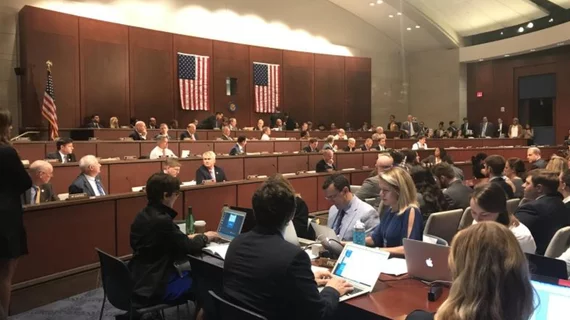
- AI could appreciably improve the delivery of healthcare services to patients—if only people trusted it. For many, the difference-maker would be nicely crafted federal regulations. A compelling case for Congress to get on the ball was made at a hearing before the House Energy & Commerce Committee’s subcommittee on health Sept. 3. The individual giving the reasoned yet impassioned testimony was Michelle Mello, JD, PhD, a professor of law and health policy at Stanford. “[P]oorly designed regulation can hinder innovation,” Mello acknowledged, but “the government has a critical role to play in ensuring the conditions for innovation to translate into greater adoption of healthcare AI. … By taking practical steps now, Congress can help make healthcare providers and the public more excited to receive the products coming out of industry, ensuring that innovation truly reaches the bedside.” Mello offered some specific policy recommendations for juicing AI adoption by building trust in its contributions. Among her suggestions: “Modify healthcare reimbursement policies to better support adoption and monitoring of effective AI tools” and “Address shortcomings in the FDA’s statutory framework to make the agency a more constructive partner in AI development and adoption.”
- The hearing was convened and moderated by Energy & Commerce chair Brett Guthrie (R-KY) along with health subcommittee chair Morgan Griffith (R-VA) and ranking member Diana DeGette (D-CO). The official exchange of ideas brought full focus to AI’s potential to upgrade U.S. healthcare. Mello was one of five witnesses who brought expert insights to the assembled lawmakers, aides and onlookers. Other notable quotes from the session (spoken before the requisite questioning began):
- “AI should be a powerful force for good. We must use it responsibly. While we acknowledge the need for thoughtful guardrails, we also have a shared responsibility to ensure that this technology democratizes healthcare and makes the best care available to all Americans, while also saving taxpayer money. … AI should be a tool that enhances care quality and access to care. AI should not replace those who provide care. This is … the model we should champion as a nation.”—Andrew Toy, chief executive of Clover Health
- “[T]he direct-to-consumer market is flooded with unregulated chatbots that make deceptive claims. Certain entertainment-based chatbots have been utilized for therapy. ... These unregulated products can provide dangerous advice. … To harness the benefits of AI while mitigating its risks, we must move forward not with blind optimism but with cautious, informed and ethical stewardship. This requires a fundamental commitment to a human-centered approach.”—C. Vaile Wright, PhD, senior director of healthcare innovation at the American Psychological Association
- “Congress can accelerate safe adoption. By creating efficient FDA pathways, aligning reimbursement with clinical outcomes, and ensuring data interoperability and accountability, lawmakers can ensure that every patient—whether in a rural critical access hospital or a major academic center—benefits from responsible, life-saving AI.”—Andrew Ibrahim, MD, MSc, chief clinical officer at Viz.ai
- To watch a video of the three-hour hearing or read the witnesses’ prepared remarks, go here.
- The hearing was convened and moderated by Energy & Commerce chair Brett Guthrie (R-KY) along with health subcommittee chair Morgan Griffith (R-VA) and ranking member Diana DeGette (D-CO). The official exchange of ideas brought full focus to AI’s potential to upgrade U.S. healthcare. Mello was one of five witnesses who brought expert insights to the assembled lawmakers, aides and onlookers. Other notable quotes from the session (spoken before the requisite questioning began):
- Patients aren’t the only healthcare VIPs whose instinct toward AI is to hope for its best while preparing for its worst. This comes through in a new survey of 101 hospital executives conducted by the vendor consultancy Sage Growth Partners. Just 1 in 10 respondents said their organizations are pursuing AI “aggressively.” Similarly, only 12% believe AI algorithms are highly reliable and 13% report having a clear strategy for integrating AI into clinical workflows. In an interview video posted Sept. 4, Sage CEO Dan D’Orazio tells Chief Healthcare Executive he’s not surprised by the widespread caution. “We’re at the very, very front end of what some people have called … the fourth industrial revolution,” D’Orazio says. “On the promising side, what we’ve seen with ambient [AI scribes] is that, finally, the human is not working for the machine. The machine is now working for the human.”
- More than half the 1,200+ AI-equipped medical devices approved by the FDA, 53%, are made and/or marketed by publicly traded companies. Yet nearly 99% of all units recalled for problems were brought to market by 92% of these companies. Further, among devices recalled for lack of clinical validation, 97% came from smaller public companies and 78% from established public companies. By comparison, the substantial ratio of devices lacking such documentation from privately held companies—4 in 10—looks pretty good. The findings are from a Johns Hopkins-led study published Aug. 22 in JAMA Health Forum. The authors remark that the strong association between public company status and higher recalls “may reflect investor-driven pressure for faster launches.” They also surmise the FDA’s 510(k) approval process “may overlook early performance failures of AI technologies.” Read the whole thing.
- Two players in the health insurance space have merged over a unified eye on AI. HealthEdge and UST HealthProof announced their consolidation Sept. 4, saying their combined strengths will bring health plans AI-enabled means for lowering costs and boosting efficiencies. The combined entity will operate as HealthEdge. Noting that the development follows Bain Capital’s recent acquisition of UST HealthProof from UST Global, HealthEdge CEO Kevin Adams says the merger “brings together best-in-class payer technology with seamless integration capabilities and experienced operational teams.” He adds that HealthEdge will look to streamline “the administrative complexity that health plans deal with every day.” Announcement.
- Develop an oversight and monitoring plan. Assign a multidisciplinary team. Review guidelines and regulatory changes. These are three of five steps the American Medical Association urges provider organizations to take so they can track AI performance as algorithm performance changes with age. “Technology is changing very quickly, clinical guidelines are changing, the way we do our work is going to shift because of these new tools,” reminds Margaret Lozovatsky, MD, the AMA’s chief medical information officer and VP of digital health innovations. “There has to be a way to continue to measure the success of these implementations over time.” More AMA thoughts and links here.
- AI-powered stethoscopes are expensive. Are they worth it? They can be—for clinicians who are open to training on them, monitoring their digital security settings and willing to part with up to $500 to get one. “Normal stethoscopes rely solely on the doctor’s ability to hear things, and even the most seasoned professional is capable of missing things fairly easily,” explains tech enthusiast Anurag Reddy at India-based Analytics Insight. “Artificial Intelligence can identify those minor variations in sound that may be an early indication that [the patient] may be getting sick.”
- From AIin.Healthcare’s sibling news outlets:
- Health Imaging: AI software triples number of stroke patients who achieve functional independence
- Radiology Business: ACR advocacy remains constant amid policy shifts in Washington
- Health Imaging: AI software triples number of stroke patients who achieve functional independence

Dave P. has worked in journalism, marketing and public relations for more than 30 years, frequently concentrating on hospitals, healthcare technology and Catholic communications. He has also specialized in fundraising communications, ghostwriting for CEOs of local, national and global charities, nonprofits and foundations.